Cybersecurity is often presented as if it were one job. It is not. A person investigating suspicious endpoint activity, an engineer designing cloud access controls, a penetration tester assessing a web application and a governance analyst reviewing organisational risk can all work in cybersecurity while spending their days on very different problems.
That distinction matters when choosing what to learn. Trying to become “good at cybersecurity” without understanding the kind of work you want to perform can lead to a scattered collection of tools and certificates. A better approach is to compare the work itself: the problems you enjoy, the evidence you like analysing, the systems you want to understand and the kind of responsibility you want to carry.
The NICE Workforce Framework for Cybersecurity is useful here because it describes cybersecurity through tasks, knowledge and skills rather than treating job titles as universal definitions. NIST also makes an important distinction: a work role is not the same thing as a job title. One real job can combine several work roles, and the same title can mean different things at different organisations.
That is why this guide uses familiar career labels such as SOC analyst, penetration tester and GRC analyst as practical groupings, not rigid boxes.
A map of common cybersecurity directions
The diagram below shows one way to think about the field. The paths overlap deliberately because cybersecurity careers rarely stay inside one lane.
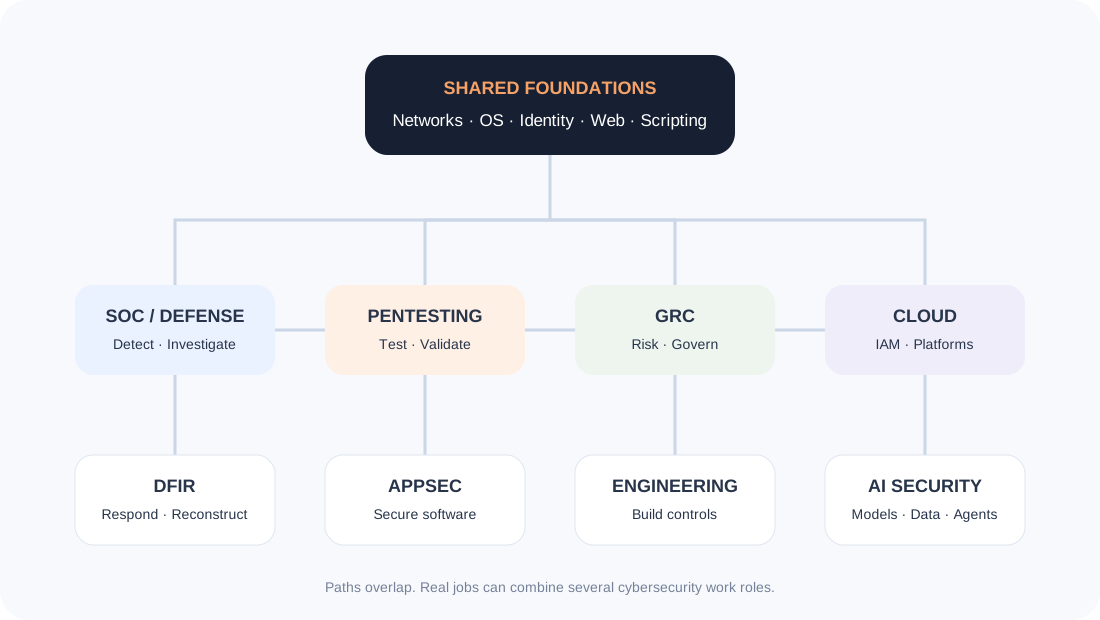
A networking foundation can support SOC work, cloud security and penetration testing. Programming can lead toward application security, security engineering or offensive research. Risk knowledge can connect GRC with architecture and cloud governance. The useful question is therefore not “Which path is best?” but “Which type of security problem do I want to become good at solving?”
1. Security operations and SOC
A Security Operations Center (SOC) focuses on detecting, investigating and responding to suspicious activity. Entry-level descriptions sometimes reduce the job to “watching alerts”, but useful analysis requires much more context.
An analyst may need to understand whether an authentication event is normal, whether a PowerShell command is suspicious, whether several weak signals form one incident, or whether an alert is simply a false positive. That means reading logs while understanding the systems that produced them.
Typical areas of work include:
- reviewing security alerts and telemetry;
- investigating endpoint, identity, network and cloud events;
- triaging suspicious activity;
- documenting incidents and escalating when necessary;
- improving detection logic and investigation procedures;
- supporting containment and recovery.
A strong foundation for this path includes networking, Windows and Linux fundamentals, authentication, common attack techniques, log analysis and basic scripting. SIEM and endpoint detection products matter, but learning only the interface of one product is fragile. The transferable skill is understanding evidence.
SOC work can develop into incident response, threat hunting, detection engineering, digital forensics, threat intelligence or security engineering.
2. Penetration testing and offensive security
Penetration testing asks a different question: how could an authorised attacker demonstrate that a weakness is exploitable, and what does that weakness mean for the organisation?
The word “authorised” is essential. Professional security testing is scoped work performed with permission. The objective is not to run the largest number of tools. It is to identify meaningful weaknesses, validate them safely and communicate enough evidence for the owner to fix them.
For web and application testing, useful foundations include HTTP, browsers, sessions, authentication, access control, APIs, databases, JavaScript and server-side application behaviour. Networking and operating-system knowledge become increasingly important for infrastructure testing.
Tools such as Burp Suite, Nmap and testing frameworks are useful, but tools should follow understanding. If a tester finds an object identifier in an API request, for example, the important reasoning is whether the server independently checks that the authenticated user is authorised to access that object. That connects directly to broken access control, not to a particular scanner.
Good penetration testers also need disciplined reporting. A technically interesting finding that cannot be reproduced, prioritised or explained to a developer has limited defensive value.
Possible later directions include application security, red teaming, security research, adversary simulation and specialised testing of cloud, mobile, embedded or AI systems.
3. Governance, risk and compliance (GRC)
GRC is sometimes incorrectly described as the “non-technical” side of cybersecurity. Some roles are less hands-on than engineering or testing, but good security governance still requires understanding what controls are supposed to achieve and how technology creates risk.
GRC work can involve:
- risk assessments and risk registers;
- security policies and standards;
- control design and evidence collection;
- regulatory and contractual requirements;
- third-party risk;
- audits and assurance;
- security awareness and governance processes.
The central skill is translating between business objectives, risk and controls. Consider a requirement for privileged access. A weak approach simply records that a policy exists. A stronger analyst asks who receives privileged access, how it is approved, how authentication is protected, how access is reviewed, what is logged and how privileges are removed.
Framework literacy is valuable. Depending on the organisation, that may include the NIST Cybersecurity Framework, NIST SP 800-53, ISO/IEC 27001 concepts or sector-specific requirements. The goal is not memorising control numbers. It is understanding why controls exist and what evidence would show that they work.
GRC can lead toward security management, risk leadership, audit, privacy, security architecture, policy and governance roles.
4. Cloud security
Cloud security sits at the intersection of infrastructure, identity, networking, automation and governance. It is not simply traditional server security moved to somebody else’s data centre.
Modern cloud environments rely heavily on identity and permissions. A storage service may be technically patched yet dangerously exposed because of an access policy. A workload may be isolated at the network layer but still have an over-privileged service identity. Infrastructure-as-code can make secure configuration repeatable, but it can also reproduce a mistake at scale.
Useful cloud-security skills include:
- identity and access management;
- virtual networking and segmentation;
- secrets and key management;
- logging and monitoring;
- storage permissions;
- container and workload security;
- infrastructure-as-code;
- cloud incident response;
- shared-responsibility reasoning.
A productive learning route is to first understand networking, Linux, identity and basic scripting, then learn one cloud platform deeply enough to build and secure small systems. The concepts transfer more reliably than memorising a catalogue of services.
Cloud security can develop toward cloud security engineering, DevSecOps, security architecture, platform security and cloud incident response.
5. Application security
Application security, often shortened to AppSec, works closely with software development. Instead of testing an application only near release, mature AppSec aims to reduce vulnerabilities throughout design, development, testing and deployment.
The work may include threat modelling, secure design reviews, code review, dependency risk, security testing, developer guidance and vulnerability management. Understanding how software is built is therefore a major advantage.
Someone interested in AppSec should learn at least one programming ecosystem well enough to read and modify real code. Web fundamentals, APIs, databases, authentication, access control and common vulnerability classes are also important. The OWASP Top 10:2025 is a useful orientation point, but an AppSec career requires moving beyond category names into design and implementation details.
For example, knowing that injection exists is basic knowledge. Being able to recognise unsafe data flow, explain why parameterisation changes the query boundary, help a developer implement the fix and add a regression test is applied AppSec work.
AppSec can lead toward product security, security architecture, secure software engineering, DevSecOps and specialised security research.
6. Security engineering and architecture
Security engineers build and integrate controls. Security architects make higher-level design decisions about how systems, identities, networks, applications and data should be protected. In smaller organisations, the responsibilities can overlap substantially.
The work might involve identity architecture, network controls, endpoint security, logging pipelines, secrets management, security automation, cloud guardrails or designing secure patterns for development teams.
This path rewards breadth because security controls interact. An engineer deploying identity controls needs to understand applications and operations. An architect deciding where trust boundaries belong needs enough technical depth to understand how the proposed system actually behaves.
These roles are often easier after experience in operations, infrastructure, development, cloud or another security specialty. They require making trade-offs rather than merely identifying problems.
7. Digital forensics and incident response
Digital forensics and incident response (DFIR) concentrates on what happened, how far it spread, what evidence remains and how to contain and recover safely.
The work can involve endpoint artefacts, logs, disk and memory evidence, timelines, malware behaviour, identity activity and network evidence. During a live incident, responders also have to balance evidence preservation against the need to stop ongoing harm.
Strong operating-system knowledge is especially valuable. So are networking, scripting, logging, common attacker behaviour and careful documentation. This path suits people who enjoy reconstructing events from incomplete evidence and working methodically under pressure.
8. AI security as an emerging specialisation
AI security increasingly combines ideas from application security, data security, identity, cloud security and adversarial machine learning. Systems that retrieve external content or allow models to call tools create security questions that conventional application controls alone do not fully describe.
For example, a retrieval-augmented generation system can inherit risks from document ingestion, retrieval permissions, prompt injection and downstream tool access. I discuss that architecture in RAG Security Explained. Agentic systems add another layer because model output may influence real actions, which makes least privilege, approval boundaries and auditability important.
This path is still developing. A sensible foundation is therefore not to skip conventional cybersecurity. Application security, identity, data protection, threat modelling and cloud fundamentals remain highly relevant to AI security.
Comparing the paths
The table is a practical orientation, not a hiring standard. Real positions vary by employer.
| Direction | Problems you often solve | Foundations that matter | Good fit if you enjoy |
|---|---|---|---|
| SOC / defensive operations | Is this activity malicious, and what should happen next? | Networking, OS, logs, identity, attack techniques | Investigation and fast evidence-based decisions |
| Penetration testing | Can an authorised attacker exploit this weakness, and what is the impact? | Networking, web, OS, scripting, application behaviour | Breaking assumptions and explaining technical risk |
| GRC | Are risks understood and controls designed, operated and evidenced appropriately? | Risk, controls, governance, communication, technical literacy | Structure, assurance and business-security translation |
| Cloud security | Are cloud identities, workloads, networks and data configured with appropriate boundaries? | IAM, networking, Linux, automation, cloud architecture | Building secure infrastructure and guardrails |
| Application security | How can software vulnerabilities be prevented or removed across the development lifecycle? | Programming, web/API security, threat modelling | Working with developers and software design |
| Security engineering | How should controls be built, integrated and automated? | Systems, networking, identity, scripting, architecture | Building reliable defensive systems |
| DFIR | What happened, what was affected and how do we contain and recover? | OS internals, logs, networking, evidence handling | Reconstruction, investigation and incident work |
| AI security | How can AI-specific trust boundaries, data flows and agent actions be abused or constrained? | AppSec, identity, data security, threat modelling, AI system architecture | Emerging systems and cross-domain security problems |
How should a beginner choose?
You do not need to choose a permanent specialty before starting. NIST’s career-pathway resources explicitly recognise that there are many starting points and many combinations of education, training and experience. CISA’s NICCS career guidance similarly encourages early-career learners to explore work roles and their associated task, knowledge and skill statements.
A practical way to choose is to run small experiments.
If SOC interests you, build a small lab and investigate authentication, endpoint and network logs. If pentesting interests you, practise legally on intentionally vulnerable applications and write a professional finding rather than stopping at exploitation. If GRC interests you, take a simple system and map realistic risks to controls and evidence. If cloud security interests you, deploy a small environment and secure its identities, network paths, secrets and logging. If AppSec interests you, build a small application, threat-model it and fix weaknesses in the code.
After each exercise, ask yourself what part you wanted to understand more deeply. Curiosity is useful career data.
Build foundations before collecting tools
Across these paths, several foundations repeatedly appear:
- Networking: IP addressing, DNS, routing, ports, protocols, TLS and how systems communicate.
- Operating systems: especially practical Windows and Linux administration, permissions, processes, services and logs.
- Identity: authentication, authorisation, sessions, MFA, privileges and service identities.
- Scripting or programming: enough to automate work, inspect data and understand software behaviour.
- Web and APIs: increasingly important across testing, AppSec, cloud and AI systems.
- Communication: the ability to explain evidence, risk, assumptions and recommended action clearly.
The weighting changes by role. A GRC analyst may need less exploit-development knowledge than a security researcher, while a penetration tester may need less audit methodology than a risk professional. Foundations are shared, not identical.
Certifications, degrees and portfolios
There is no single credential sequence that defines a cybersecurity career. The NICE Framework itself is built around work and learner capabilities rather than prescribing one universal certification ladder.
A degree can provide structured computing and security foundations. Certifications can provide a syllabus, external assessment and evidence of focused study. Labs and portfolios can demonstrate how you apply knowledge. Work experience shows that you can operate within real constraints. These signals complement one another rather than replacing one another automatically.
When building a portfolio, prefer artefacts that show reasoning: a threat model, a detection explanation, a secure application, a lab report, a risk assessment or a carefully scoped security test. A screenshot of a tool is much weaker than an explanation of the problem, method, evidence, limitations and remediation.
Do not optimise your career around job titles alone
Job titles are inconsistent. NIST explicitly distinguishes jobs and occupations from NICE work roles, and a single job can include more than one work role. This is why searching only for one title can hide relevant opportunities.
Read the responsibilities. Look for the systems you would work with, the decisions you would make and the evidence you would be expected to produce. A role called “security analyst” might be SOC-heavy at one company, vulnerability-management focused at another and GRC-oriented somewhere else.
The same principle helps with learning. Instead of asking “Which ten tools should a cybersecurity student learn?”, ask “What task am I trying to perform, what knowledge does it require, and what tool helps me perform it safely?”
A simple decision framework
When comparing two paths, score them informally against four questions:
- Problem: Do I enjoy the type of problem this role repeatedly solves?
- System: Do I want to understand the underlying systems deeply?
- Evidence: Do I enjoy the evidence this work uses, such as logs, code, controls, packets or architecture?
- Output: Do I enjoy producing what the role requires, such as incident decisions, findings, designs, policies or secure code?
A career direction that fits all four is usually a better long-term learning target than one selected only because a particular tool or title is popular.
Cybersecurity careers are flexible. NIST describes the field in modular tasks, knowledge and skills for a reason: people can build capabilities, combine work roles and move between specialties over time. Start with sound computing foundations, choose a problem area that holds your attention, build something that demonstrates the work, and then deepen the skills that the work actually demands.